Won a Big Contract? Here’s How to Fund It Before You Get Paid

You just landed one of the biggest projects your company has ever won. At first, it feels like a major victory. The contract is signed. The revenue looks great. Your team is excited. Then reality sets in. Before the first payment arrives, you need to hire additional workers, order materials, mobilize equipment, and cover payroll. The project may be profitable, but it requires cash today while customer payments may not arrive for weeks or even months. Many contractors discover that winning a larger project creates a new challenge: having enough working capital to get the job started. The Contractor Growth Challenge One of the biggest misconceptions in business is that profitability automatically means financial stability. For contractors, that’s often not the case. A company can be profitable on paper and still experience cash flow pressure because expenses happen long before project payments are received. Common upfront costs include: Payroll for field crews and supervisors Materials and supplies Equipment rentals and transportation Permits and mobilization costs Subcontractor deposits Fuel and operating expenses As project size increases, these costs increase as well. The question becomes: If a larger contract landed on your desk tomorrow, would your current cash flow support it? Why Many Contractors Turn Down Growth Opportunities When funding is needed, many business owners immediately think of traditional bank loans. Historically, banks often required collateral such as: Real estate Heavy equipment Vehicles Other business assets For some contractors, that works. For many others, it creates challenges. Some equipment may already be financed. Some owners prefer not to put personal assets at risk. Others simply do not want to wait through lengthy approval processes while a project timeline is moving forward. As a result, many contractors pass on opportunities that could help grow their business. A Different Approach to Business Funding Today’s funding landscape offers more options than many contractors realize. Rather than focusing only on collateral, many funding programs evaluate the overall strength of the business. Factors often include: Consistent Revenue Steady monthly revenue demonstrates that the company is operating successfully and generating income. Business Cash Flow Lenders want to understand how money moves through the business and whether there is capacity to support additional financing. Time in Business A proven operating history shows experience, stability, and the ability to manage projects successfully. Project Pipeline Upcoming contracts and future opportunities can help demonstrate growth potential and the purpose behind the requested funding. For contractors with strong operations and predictable revenue, these factors may be more important than the value of physical assets. The Best Time to Explore Funding The most successful contractors usually don’t wait until they are facing a cash crunch. Instead, they explore financing options before they need them. When a major project appears, they already understand: What funding options are available How much capital they may qualify for What documentation is required How quickly funding can be accessed Preparation creates flexibility and confidence when opportunities arise. Key Takeaways Cash Flow Matters More Than Profit A profitable project can still create financial strain if expenses come due before customer payments arrive. Growth Requires Capital Larger contracts often require additional labor, materials, equipment, and working capital. Traditional Banks Are Not the Only Option Modern funding solutions may focus on business performance, revenue, and future opportunities rather than solely on collateral. Your Future Work Has Value A strong pipeline of contracts can demonstrate business strength and growth potential. Plan Before You Need Funding Understanding your options ahead of time allows you to move quickly when the right opportunity appears. Final Thoughts Many contractors don’t struggle because they lack profitable work. They struggle because growth requires cash before customers pay. The good news is that funding options have evolved. Business owners today may have access to solutions designed specifically for established companies that need capital for expansion, equipment, acquisitions, payroll, inventory, or large projects. If you’re wondering whether your business could qualify for funding, a simple conversation can often provide clarity without any obligation or pressure. Learn More: https://www.youtube.com/watch?v=SWaeEqyuvSU Devil Dog Marketplace, Proud Partner of National Business Capital Website: https://www.devildogmarketplace.com LinkedIn: https://www.linkedin.com/in/michaelfieger/ National Business Capital: https://www.nationalbusinesscapital.com Funding Application: https://www.nationalbusinesscapital.com/apply-now/?ref=5466172
Emergency Funding vs. Bridge Capital: How to Tell Which One Your Business Actually Needs
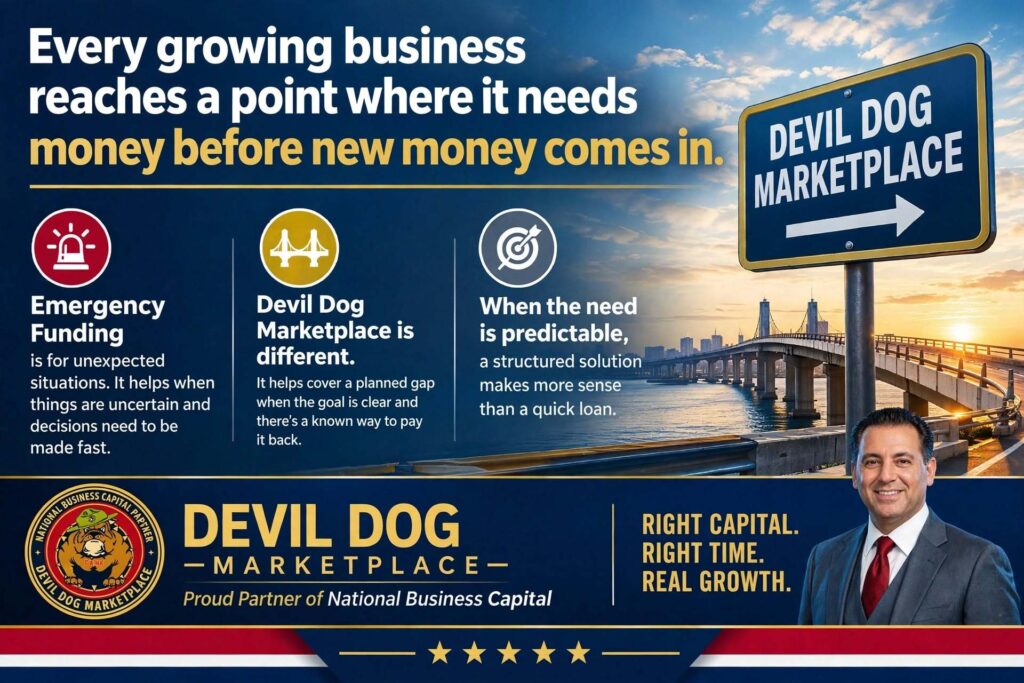
Not every cash-flow gap means something’s wrong. Sometimes it just means the timing hasn’t caught up yet. I get calls from business owners who think they need “emergency funding,” and by the time we’ve talked it through, what they’re actually describing isn’t an emergency at all. It’s a gap they already saw coming — a retailer’s purchase order, a sale that’s 60 days from closing, inventory that has to be paid for before the season’s revenue lands. They already know the money is coming. They just need something to cover the space between now and then. What Emergency Funding Is Actually For Emergency funding exists for the moment nobody saw coming. A piece of equipment fails and stops production. A client pays 45 days late and payroll’s due Friday. Something forces a fast decision while you’re still figuring out what happened. In situations like that, speed matters more than structure — the goal is stability, not strategy. What Bridge Capital Is Actually For Bridge capital solves a different problem. The objective is already clear, and so is how it gets repaid. That could look like: Covering payroll and operating costs ahead of a receivable you’re already owed Funding inventory before a seasonal or retail sales cycle Bridging a transaction while permanent financing is being finalized Managing the timing gap between an investment and the proceeds it will generate None of that is a crisis. It’s math with a known ending — you just need the right capital to get from point A to point B without stalling out in between. The Question I Ask First Before we ever get into rates or structure, this is what I want to understand: did this catch you off guard, or did you already see it coming? That answer changes everything about what kind of funding actually fits — and it’s usually more revealing than the number itself. Why This Distinction Matters Getting this wrong costs business owners more than they realize. Treating a predictable, plannable gap like an emergency often means paying emergency-level pricing for a problem that didn’t need to be urgent. And treating a genuine emergency like a planned transaction can mean losing precious time you don’t have. At Devil Dog Marketplace, in partnership with National Business Capital, we work through both situations regularly — with the speed to move fast when something’s genuinely urgent, and the flexibility to structure something more deliberate when the timeline allows for it. Every deal we fund also contributes to Feeding America, so growing your business supports a cause bigger than the transaction itself. If you’re staring at a gap right now, ask yourself the same question I’d ask on a call: is this the surprise kind, or the kind you already saw coming? Once you know the answer, we can talk about what actually fits.
Rates Dropped. Should You Refinance Your Business Debt?

If you financed anything for your business in 2023 or 2024, you locked in a rate at the worst possible time. The Fed’s benchmark rate was sitting near its highest point in over a decade, and whatever you borrowed then, you borrowed expensive. That’s changed. The Fed cut rates three times in the second half of 2025, and the prime rate has held around 6.75% through 2026. If you’re still paying off debt from that high-rate window, there’s a real chance you’re overpaying right now — not because you did anything wrong, but because timing is timing. Why this is worth 15 minutes of your time Here’s what I’m seeing across the businesses I talk to: the reason for seeking capital has shifted. It used to be mostly about expansion — a new location, a piece of equipment, a growth bet. Now, a lot of it is about staying ahead of rising operating costs. Tariffs, wages, insurance — the day-to-day cost of running a business has climbed, and cash flow is the thing owners are protecting first. If that’s you, and you’re also sitting on debt from 2023 or 2024, you may be solving the same problem twice: tight cash flow today, plus a legacy rate that’s higher than what’s available now. Refinancing can address both at once — not by adding new debt, but by restructuring what you already owe on better terms. What refinancing actually does Refinancing means replacing an existing loan with a new one — ideally at a lower rate, a longer term, or both. Done right, it can: Lower your monthly payment, freeing up cash for operations Reduce the total interest you’ll pay over the life of the loan Consolidate multiple debts (including higher-cost products like merchant cash advances) into one predictable payment Extend your term to match your actual cash flow cycle, instead of one that was forced on you at the time It’s not automatic savings. Refinancing has its own costs — sometimes prepayment penalties on the old loan, sometimes origination fees on the new one. The math has to work in your favor once those are factored in, which is exactly why this isn’t a decision to make off a headline about rate cuts. It’s a decision to make off your actual numbers. Questions worth asking before you refinance What rate are you actually paying right now? Not the rate you remember agreeing to — the effective rate today, including any fees baked into your payment structure. Is there a prepayment penalty on your current loan? If there is, it needs to be smaller than what you’d save by refinancing, or the move doesn’t pencil out. How much time is left on the loan? Refinancing a loan with six months left rarely makes sense. Refinancing one with three years left almost always deserves a second look. Is the debt you’re carrying high-cost, short-term financing? If part of your capital stack is a merchant cash advance or another fast-but-expensive product taken on during a tighter moment, that’s usually the first thing worth restructuring. When it’s not worth it Refinancing isn’t the right move for everyone, and I’d rather tell you that upfront than have you find out after signing something. If you’re close to paying off the loan, if the fees eat most of the savings, or if your business is in the middle of a stretch where taking on any new paperwork or underwriting review would be a distraction — it’s fine to wait. A lower rate that costs you operational focus at the wrong moment isn’t actually a win. The point isn’t to refinance for the sake of it. It’s to know where you stand, so the decision is yours to make with clear numbers in front of you — not a guess. Where to start If you’re not sure whether refinancing makes sense for your situation, the fastest way to find out is to actually run the numbers on what you’re carrying now against what’s available today. That’s the conversation I have with business owners every week — no pressure, no obligation, just a clear look at whether the math works in your favor. Every deal we help fund also contributes to Feeding America, so getting your capital structure right does a little more good along the way.