It Wasn’t One Big Check: Inside a Staged Growth Financing Story
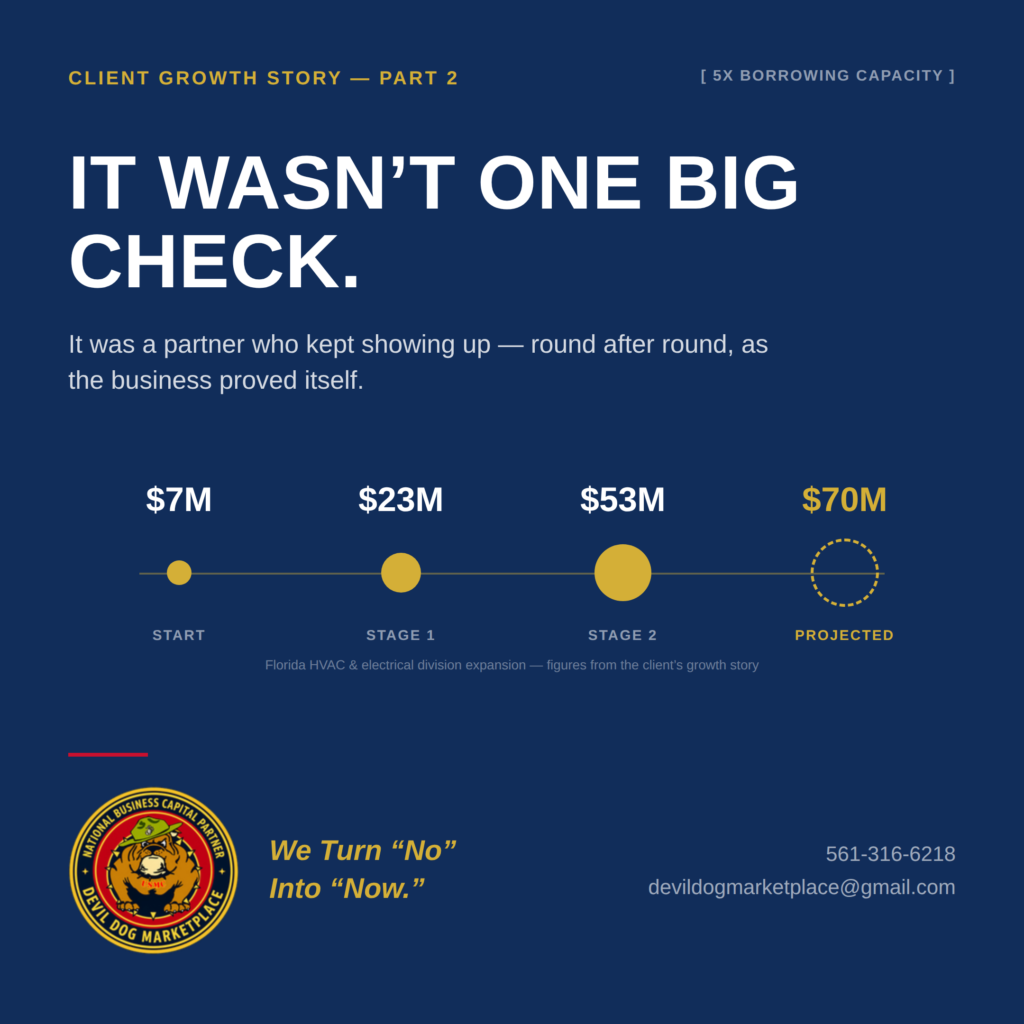
Last week I shared how a $250K loan got an HVAC owner through his slow season after a past bankruptcy had shut most lenders’ doors. What happened next is the part that stuck with me even more. Once stable, he wanted out of the seasonal cycle entirely — Florida HVAC means strong summers and quiet winters, no matter how well you run the business. He already had an electrical division. It just wasn’t big enough to carry the company through the slow months. Growing it meant more trucks, more electricians, real overhead before the revenue caught up. His lender didn’t just approve a lump sum — they staged it. Ten trucks, then twenty, then twenty more, each wave given time to settle before the next arrived. They even timed the purchases to capture a tax deduction on the equipment. The relationship scaled his borrowing capacity 5x over time. The business went from $7M to $23M to $53M, with $70M projected next. What gets me about this one is the sequencing. It wasn’t one big check — it was a partner who kept showing up as the business proved itself, round after round. If your business is working through a similar growth bottleneck, I’m glad to talk through what staged capital planning could look like for you.
How $900K in Cash Flow Financing Kept Supra’s NYC Expansion From Stalling Out

A brutal winter delayed construction on two new Supra locations by two months, creating $2 million in unplanned revenue loss. A $900,000 Cash Flow Financing facility from National Business Capital kept the restaurant group stable until both doors could finally open.
Client Success: How Caldwell Contracting Funded a Full Spring Season in Days

When Caldwell Contracting Corp headed into their busy season, they had six to eight active projects starting at once — contract values ranging from $600K to $5M each. That’s a good problem to have, but it’s still a problem: payroll, materials, supplies, and transportation all had to be funded up front, while collections followed milestone-based Net 60 to Net 90 payment cycles. The opportunity was there. The season was moving faster than the cash conversion cycle. What made Caldwell’s file strong wasn’t complicated. Fourteen years in business. Strong credit. Predictable deposits. Repeatable contract flow. Those are exactly the markers that carry more weight when credit conditions tighten — but the performance history alone wasn’t the holdback. Underwriting timing was. That’s what made a reduced-documentation review the right path. Rather than restarting underwriting from zero, Caldwell secured $500K in Cash Flow Financing structured around the strength already built into their file. With that capital in place, Caldwell was able to cover upfront payroll, materials, supplies, and transportation; start multiple spring contracts on time; support active project mobilization across a busy seasonal ramp-up; and move forward without waiting on milestone-based collections. The lesson here isn’t really about Caldwell specifically — it’s about what their file represented. When a business has already proven its strength through tenure, credit, and consistent revenue, the right capital path recognizes that instead of asking the business to prove it all over again. In a seasonal industry like construction, that distinction is the difference between a season that ramps up on schedule and one that stalls waiting on paperwork.