Why Banks Reject Small Business Loans (And What They Won’t Tell You)

If you’ve ever walked out of a bank meeting with a “no” and no real explanation, you’re not alone — and it’s not because your business isn’t fundable. It’s because traditional banks aren’t built to explain their decisions. Here’s what’s actually happening behind the scenes: Automated underwriting, not human judgment. Most banks run applications through a scoring model first. If you don’t hit certain thresholds — time in business, credit score, debt-to-income ratio — you’re filtered out before a loan officer ever reviews your file. Rigid box-checking, not real business context. Banks are built for stability, not nuance. A strong contract pipeline, a seasonal dip, or a recent equipment investment — the things that actually tell your business’s story — often don’t factor into their models at all. Liability, not partnership. Bank loan officers are compliance-driven. Explaining a denial in detail can create legal exposure, so most are trained to give a form letter, not a conversation. What this means for you: a denial from a bank tells you almost nothing about whether your business is actually fundable — only that it didn’t fit one institution’s narrow criteria. What a real conversation looks like instead At National Business Capital, we don’t run your business through a black box. We look at the full picture — revenue trends, industry, what the capital is actually for — and we tell you plainly what you qualify for and why. No vague form letters. No guessing games. Speed: Most owners get a real answer in 24-48 hours, not weeks of silence. Flexibility: We work with businesses banks pass on — including less-than-perfect credit — because we look past the score to the story. Transparency: If something doesn’t work, we tell you exactly why, and what would need to change. And every deal we fund contributes to Feeding America — so growing your business also means feeding families in need. If you’ve been denied and never got a straight answer, let’s have that conversation.
It Wasn’t One Big Check: Inside a Staged Growth Financing Story
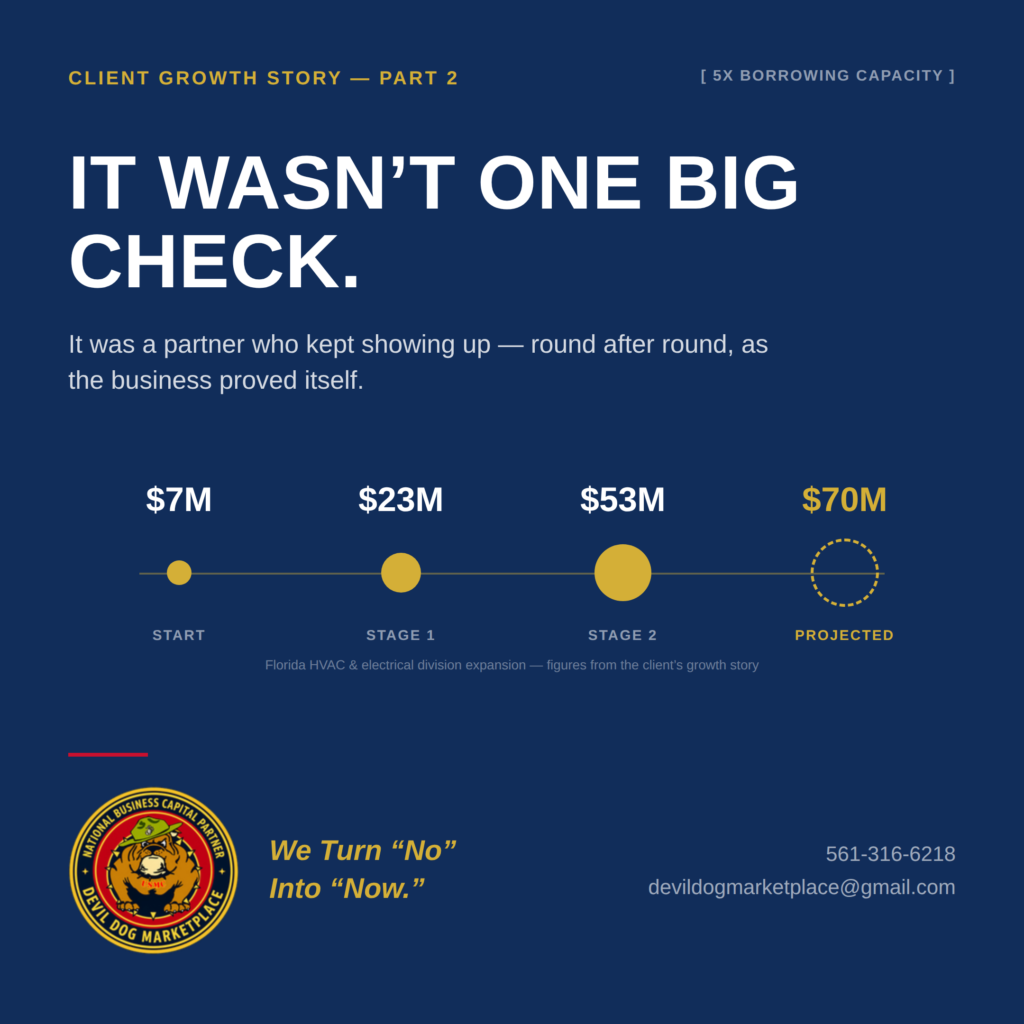
Last week I shared how a $250K loan got an HVAC owner through his slow season after a past bankruptcy had shut most lenders’ doors. What happened next is the part that stuck with me even more. Once stable, he wanted out of the seasonal cycle entirely — Florida HVAC means strong summers and quiet winters, no matter how well you run the business. He already had an electrical division. It just wasn’t big enough to carry the company through the slow months. Growing it meant more trucks, more electricians, real overhead before the revenue caught up. His lender didn’t just approve a lump sum — they staged it. Ten trucks, then twenty, then twenty more, each wave given time to settle before the next arrived. They even timed the purchases to capture a tax deduction on the equipment. The relationship scaled his borrowing capacity 5x over time. The business went from $7M to $23M to $53M, with $70M projected next. What gets me about this one is the sequencing. It wasn’t one big check — it was a partner who kept showing up as the business proved itself, round after round. If your business is working through a similar growth bottleneck, I’m glad to talk through what staged capital planning could look like for you.
150-Day Delay, $3M Project: How Monarch Construction Kept Growing

A 150-day delay on a $3M project nearly stalled Monarch Construction’s cash flow. Watch how National Business Capital helped them secure $500,000 to launch two new contracts, fast. Watch the full story: https://youtu.be/q3O-9Ezckxs Facing a similar cash-flow squeeze? Call Michael at Devil Dog Marketplace: 561-316-6218
How Monarch Construction Overcame a 150-Day Delay With $500K in Fast Business Funding

A 150-day delay on a $3 million project could have sunk Monarch Construction’s cash flow — and their ability to take on new work. In this video, we break down exactly what happened, and how National Business Capital stepped in to secure $500,000 in growth capital, giving Monarch the breathing room to launch two new contracts without missing a beat. https://youtu.be/q3O-9Ezckxs Facing a similar cash-flow crunch? Project delays happen. What matters is having a funding partner who can move fast, without the red tape of a traditional bank. If your business needs capital to bridge a gap, launch a new contract, or keep growth on track, let’s talk. Call Michael Fieger at Devil Dog Marketplace: 561-316-6218
How $900K in Cash Flow Financing Kept Supra’s NYC Expansion From Stalling Out

A brutal winter delayed construction on two new Supra locations by two months, creating $2 million in unplanned revenue loss. A $900,000 Cash Flow Financing facility from National Business Capital kept the restaurant group stable until both doors could finally open.
How Fast Can You Actually Get Business Funding? A Real Timeline Breakdown

When your business needs capital, “soon” isn’t good enough — you need to know exactly how many days you’re looking at, because that number determines whether an opportunity is still on the table when the money arrives. Here’s the real timeline, side by side: Traditional bank term loan: 30-90 days. Between paperwork, underwriting committees, and manual review, most banks weren’t built for speed — they’re built for caution. If your need is time-sensitive, this timeline alone can rule banks out. SBA loans: 60-90+ days. Government-backed guarantees mean extra layers of documentation and approval. Reliable, but rarely fast. Alternative/private lending through National Business Capital: 24-72 hours to a real answer, funding often within days. We use reduced-documentation review and a network of private lenders built for speed — not a single institution’s slow-moving process. Why the gap is so wide Banks are optimized to minimize their own risk across thousands of nearly identical applications. We’re optimized to understand your business quickly — your revenue trends, your industry, what the capital is actually for — so we can move as fast as the opportunity in front of you requires. Speed: Real answers in 24-48 hours is standard, not the exception. Flexibility: We work with businesses that don’t fit a bank’s rigid box, including less-than-perfect credit. Transparency: You’ll know your realistic timeline upfront — no vague “it depends” answers. And every deal we fund contributes to Feeding America, so moving fast for your business also does good beyond it. If timing is the reason you haven’t applied yet, let’s talk about what’s actually possible this week.
Revenue-Based Loans: Everything You Need to Know

If you’ve been turned away by a bank, or you just don’t want to hand over equity to grow your business, revenue-based financing is worth understanding. It’s one of the most flexible funding tools available to small and mid-sized businesses today — and it’s built around a simple idea: you repay based on what you actually earn, not on a fixed schedule that doesn’t care how your month went. 💰 Here’s a straightforward breakdown of how it works, who it’s built for, and what to watch out for. What Is a Revenue-Based Loan? A revenue-based loan (RBL) — sometimes called revenue-based financing (RBF) — provides your business with a lump sum of capital upfront. In exchange, instead of a fixed monthly payment, you repay a percentage of your monthly revenue until the agreed-upon amount is satisfied. Think of it like a business partner who only gets paid when you get paid. Slow month? Your payment shrinks with it. Strong month? You pay a bit more and move toward payoff faster. There’s no fixed end date carved in stone — repayment moves at the pace of your business. How It Actually Works You receive funding — typically based on your historical and projected monthly revenue, not just your credit score. You agree to a repayment percentage — usually somewhere between 2% and 20% of monthly gross revenue, depending on the lender and your business profile. Payments flex with your sales — collected daily, weekly, or monthly as a percentage of what comes in. The loan is considered repaid once the total agreed amount (principal plus fee) has been collected — there’s no fixed number of years hanging over your head. Why Business Owners Choose It ⚡ Speed. Revenue-based financing typically moves far faster than a bank. Where a traditional bank loan can take weeks or months of underwriting, revenue-based approvals and funding often happen in days — sometimes as little as 24-48 hours once documents are in. Flexibility for real-world credit situations. Approval leans heavily on your business’s revenue and cash flow, not just your personal credit score. That opens the door for owners who’ve been shut out by traditional bank underwriting. Payments that move with your business. Because payments are tied to revenue, this option is especially strong for: Seasonal businesses (landscaping, retail, HVAC) Businesses with fluctuating monthly income Companies that don’t want to pledge hard collateral No equity given up. You’re not selling a piece of your company to get capital — you keep full ownership and full control. What to Watch Out For Transparency matters here, so let’s be straight about the trade-offs: Cost of capital can run higher than a traditional bank term loan, since the lender is taking on more flexibility and more risk. Because payments scale with revenue, growth speeds up payoff — and a stronger month means a bigger payment, so it’s worth mapping out how that affects cash flow during your best seasons. Not every lender structures deals the same way. Capture rates, fees, and total repayment amounts vary significantly — this is exactly where having a partner who shops multiple lenders on your behalf pays off, instead of taking the first offer that lands in your inbox. Straight From Our CEO: The Collateral Gap Our own CEO and founder, Joe Camberato, breaks this down well on his YouTube channel, Grow By Joe. His take gets right to the heart of who this product is actually built for. Banks generally underwrite around four core pieces of collateral: Real estate Heavy machinery/equipment B2B receivables Inventory If your business doesn’t check those boxes — say you’re a direct-to-consumer business without B2B receivables, physical inventory, or hard equipment sitting on your balance sheet — a bank is going to have a hard time lending to you, no matter how well you’re running things. And even if you do have strong profit and cash reserves, that alone often isn’t enough to move a bank. There’s also a scale problem. Banks today are increasingly focused on larger deals — often $10 million, $25 million, $50 million and up. That’s created a real gap in the market for the small and mid-sized businesses doing meaningful revenue but not billion-dollar balance sheets. That gap is exactly where revenue-based financing lives. If your business doesn’t have the B2B receivables, inventory, or hard collateral a bank wants to see, revenue-based financing is often the most realistic — and fastest — path to capital. Is It the Right Fit for Your Business? Revenue-based financing tends to make the most sense when: You’re a direct-to-consumer business without the traditional collateral banks look for (real estate, equipment, B2B receivables, inventory) You need capital quickly Your revenue is strong but your credit or collateral picture isn’t bank-perfect You want funding that breathes with your business rather than fighting against it It’s commonly used to fund marketing pushes, inventory, hiring, and equipment — the kind of near-term growth moves that pay for themselves. It’s not automatically the cheapest option on paper. But for a lot of business owners, the speed and flexibility are worth more than shaving a few points off the cost — because capital that shows up in days, structured around your actual cash flow, is capital you can actually use. The Bottom Line Revenue-based loans exist to solve a real problem: traditional banks move slowly and demand a level of credit perfection that most growing businesses simply don’t have. This isn’t about settling for less — it’s about finding a funding structure that matches how your business actually generates income. At National Business Capital, every conversation starts with understanding your business first — not pushing a product. We’ll walk you through whether revenue-based financing is the right fit, or whether another option in the capital stack serves you better. And every deal we fund helps provide meals through our partnership with Feeding America 🍽️ — so growing your business does a little good beyond your own four walls too. If you’re weighing your
When the Bank Says No, Your Plans Don’t Have to Stop

You’re staring at a payroll spreadsheet, the bank’s approval email still hasn’t come, and a supplier is asking if they’ll get paid Monday. That hollow feeling isn’t just stress — it’s the moment more and more business owners are hitting in 2026, as traditional banks pull back and get slower, pickier, and harder to reach. Loans Aren’t Paperwork — They’re Oxygen Here’s what’s changed: cash needs don’t pause for bureaucracy. When the bank says no, or takes three weeks to say maybe, you don’t have time for a wish list of financing options. You need a clear path that matches what you actually need — the amount, the timing, the reason — to capital that can move fast. The Real Gap Isn’t Your Business — It’s How the Ask Was Framed Name the objective. Name the number. Name the deadline. Do that, and you stop waiting on a bank’s timeline and start moving on your own. A Conversation, Not a Pitch Michael Fieger and Devil Dog Marketplace, a proud partner of National Business Capital, help business owners navigate exactly this. No pressure, no pitch — if the bank said no and you’re not sure what’s next, that’s a conversation worth having.
Letting Go of What No Longer Serves Your Growth

One of the toughest realities in business is realizing that not everything that helped you get here will help you get where you want to go next. Many business owners continue investing time, money, and energy into customers, services, partnerships, or processes simply because they’ve been part of the business for a long time. The history creates a sense of loyalty. After all, these relationships and decisions may have played an important role in your growth. But business isn’t built on history alone. It’s built on what creates value today and what positions you for tomorrow. You may have clients who were once ideal but now require more effort than the revenue they generate. You may have services that used to be profitable but have become distractions from larger opportunities. You may even have systems, vendors, or partnerships that no longer align with the direction you’re heading. That doesn’t mean they were mistakes. It simply means your business has grown. Healthy businesses regularly take a step back and ask difficult questions: – What’s generating the greatest return on our time and resources? – What’s helping us move forward? – What’s consuming energy without creating meaningful results? – If we were starting this business today, would we make the same decisions? The most successful companies aren’t afraid to make adjustments. They understand that growth often requires refining priorities, reallocating resources, and creating space for new opportunities. Cash flow is limited. Time is limited. Attention is limited. Where you invest those resources has a direct impact on the future of your business. Sometimes growth isn’t about doing more. Sometimes it’s about having the courage to let go of what’s no longer serving your goals so you can focus on what will. To your growth and success,
The Funding Questions Every Business Owner Must Answer Before Raising Capital

Learn the most common investor, lender, and grant funding questions about traction, financials, use of funds, competition, and growth milestones before applying for capital.